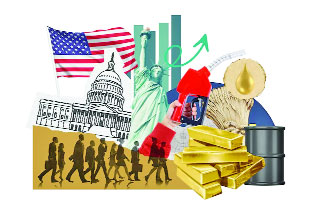
Just as the US economy was showing signs of a gradual recovery after enduring a year of trade wars, immigration crises and other economic shocks, a new cloud of uncertainty has loomed. Former US President Donald Trump’s sudden military action aimed at overthrowing Iran’s Islamist regime has shaken global politics and economics. Analysts fear that the conflict will not only change the geopolitics of the Middle East, but also create a new wave of instability in global markets.
The impact on the energy market was immediate. Oil prices rose rapidly from $70 per barrel to around $80. The biggest concern is the Strait of Hormuz, one of the world’s main routes for energy supplies. Disruption of shipping through this route could seriously threaten global energy security. Although the United States, with its own oil and gas production, is relatively less directly affected by the energy crisis, it is difficult to avoid negative effects on global trade, inflation and investment. The positive signs of growth that were seen at the beginning of the year are now in question.
Business confidence is also uncertain. While optimism among CEOs has increased in various surveys, geopolitical tensions have become a major obstacle. Although the World Bank previously gave a positive assessment of the US economy, the conflict in the Middle East could change that calculation.
Economists say the impact of the crisis will depend largely on how long the conflict lasts and how much oil prices rise. The situation is particularly complicated for the Federal Reserve. If inflation rises, it could delay plans to cut interest rates. Former Fed Chair Janet Yellen has warned that the impact of the war could increase inflation on the one hand, and reduce growth on the other-making policymaking more difficult.
Analysts also fear that Iran could resort to asymmetric tactics rather than direct war. The dominant military, the Islamic Revolutionary Guard Corps, could resort to cyberattacks, proxy wars or attacks on energy infrastructure. In such a situation, if oil prices exceed $120, the global supply system would risk collapsing.
Overall, the global economy is now facing two possibilities - the conflict will end quickly and stabilize markets, or it will become protracted and deal a major blow to global trade and growth. The biggest challenge for investors and policymakers in this time of uncertainty is to make the right decisions in line with the rapidly changing situation.